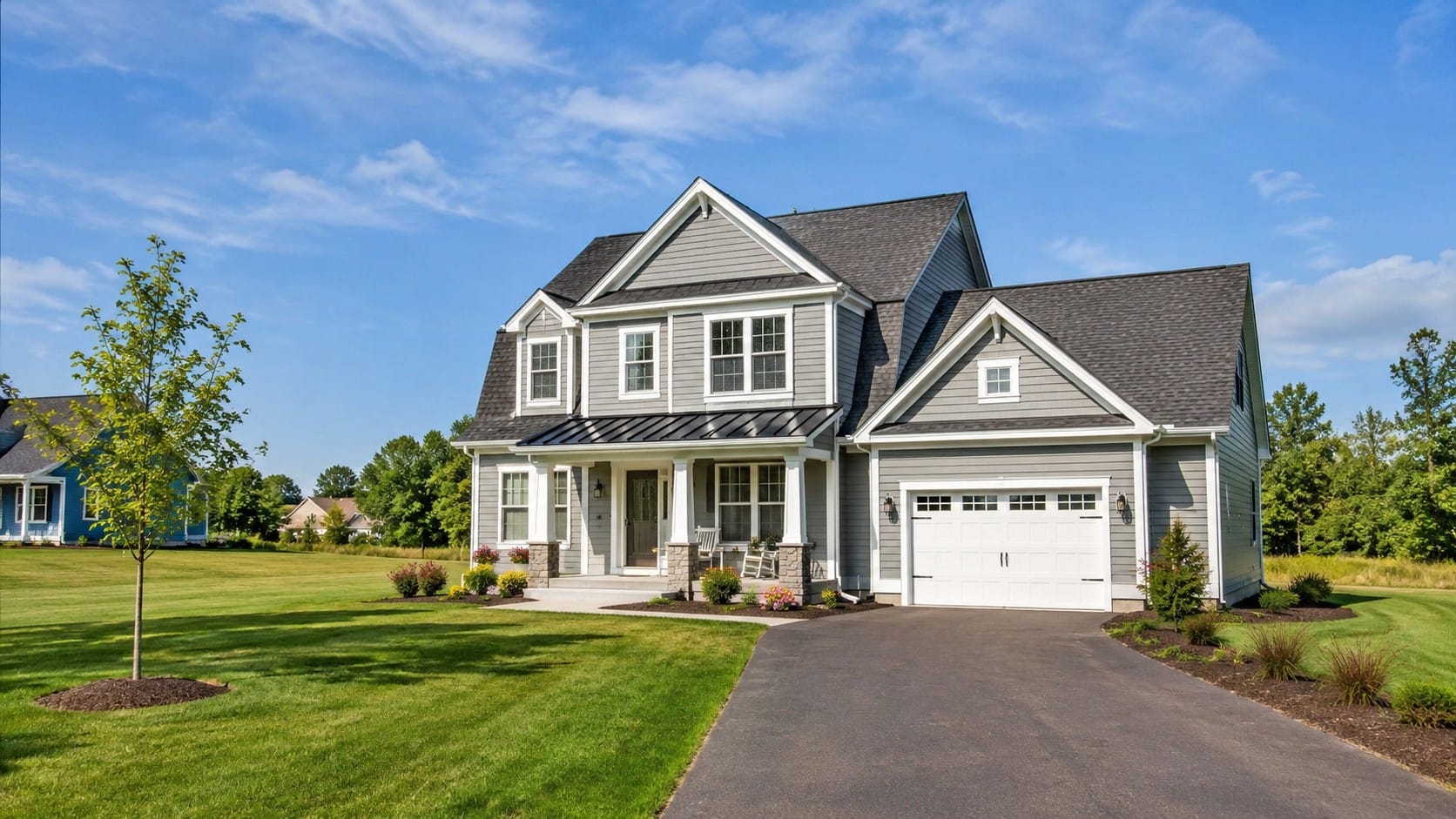
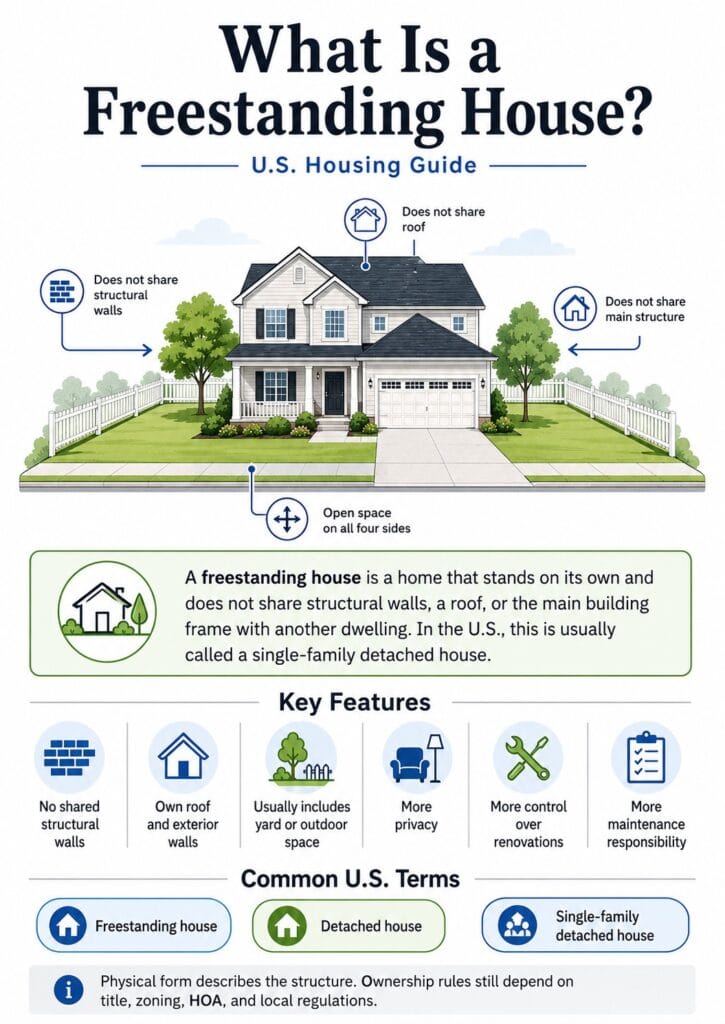
A freestanding house is a home that stands on its own and does not share structural walls, a roof, or the main building frame with another dwelling. In the United States, this type of home is usually called a single-family detached house or simply a detached home.
Many buyers like freestanding houses because they usually offer more privacy, more outdoor space, and more control than attached housing. However, this control comes with more responsibility. The owner usually handles the roof, siding, yard, driveway, fences, drainage, utilities, insurance, taxes, and repairs.
Before buying one, it is important to understand what “freestanding” means in the U.S. housing market. It is also important to compare it with related terms such as single-family home, semi-detached house, townhouse, condo, co-op, and apartment.
This guide explains the meaning of a freestanding house in the U.S., how it differs from other housing types, what it costs to own, what legal issues to check, and how to decide whether buying or building one makes sense.
What Is a Freestanding House?
A freestanding house is a residential building that stands independently and does not share its main structure with another home. It has its own exterior walls, roof, entrance, and usually some space around the structure.
In the U.S., the more common real estate term is single-family detached house. This means the home is designed for one household and is physically detached from other homes.
A freestanding house usually has:
- No shared structural walls with another dwelling
- No unit above or below it
- Its own roof
- Its own exterior walls
- Its own entry
- Direct access to outdoor space
- More control over exterior changes, subject to local rules
- More direct maintenance responsibility
The word “freestanding” describes the physical structure. It does not automatically explain every legal detail. A freestanding house may still be part of a subdivision, HOA community, planned unit development, or condominium-style ownership arrangement.
Freestanding House vs. Detached House
In the U.S., “freestanding house” and “detached house” usually mean the same thing in everyday language. Both refer to a home that does not touch another dwelling.
However, “detached house” or “single-family detached house” is more common in U.S. real estate listings, housing data, and government definitions.
Use this simple rule:
- Freestanding house describes a home that physically stands alone.
- Detached house is the common U.S. real estate term for the same idea.
- Single-family detached house means the home is detached and intended for one household.
Freestanding House vs. Single-Family Home
A freestanding house is often a single-family home, but the terms are not always identical.
A single-family home is a home designed for one household. It can be detached or attached. For example, a townhouse can be a single-family home because one household occupies it, but it may still share walls with neighboring homes.
A freestanding house focuses on the building form. It means the house is physically separate.
So, the clearest distinction is:
- A freestanding house is about physical separation.
- A single-family home is about household use.
- Many freestanding homes are single-family homes.
- Not all single-family homes are freestanding.
Housing Types in the U.S. Explained
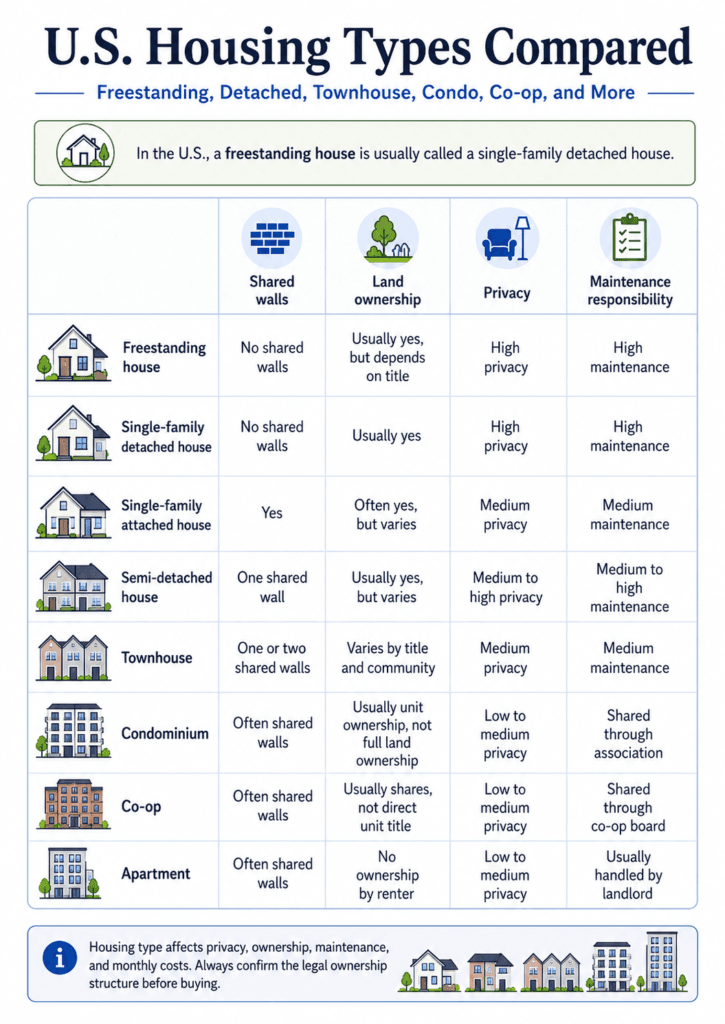
Different U.S. housing terms can overlap. The table below explains the practical differences.
| Housing Type | What It Means in the U.S. | Shared Walls | Land Ownership | Privacy | Maintenance Responsibility |
|---|---|---|---|---|---|
| Freestanding house | A house that stands independently without shared structural walls | No | Usually yes, but depends on title | High | High |
| Single-family detached house | A detached home designed for one household | No | Usually yes | High | High |
| Single-family attached house | A one-household home attached to another unit, often by a ground-to-roof wall | Yes | Often yes, but varies | Medium | Medium |
| Semi-detached house | One of two homes joined by one shared wall | One side | Usually yes, but varies | Medium to high | Medium to high |
| Townhouse | A home attached side by side to other homes, often with a private entrance | One or two sides | Varies by title and community | Medium | Medium |
| Condominium | A form of ownership where a person owns a unit and shares common areas | Often yes | Usually unit ownership, not full land ownership | Low to medium | Shared through association |
| Co-op | A cooperative ownership structure where residents own shares in a corporation | Often yes | Usually shares, not direct unit title | Low to medium | Shared through co-op board |
| Apartment | Usually a rented unit in a larger building or complex | Often yes | No ownership by renter | Low to medium | Usually handled by landlord |
Freestanding House vs. Semi-Detached House
A semi-detached house is one of two homes connected by one shared wall. It gives more privacy than many townhouses, but it is not fully detached.
A freestanding house has no shared structural wall. A semi-detached house shares one wall with another home.
Choose a freestanding house if you want:
- Maximum physical separation
- Less shared-wall noise
- More privacy
- More outdoor control
- More design flexibility
Consider a semi-detached house if you want:
- Lower cost than many detached homes
- Some outdoor space
- Fewer shared walls than a townhouse
- A balance between privacy and affordability
Freestanding House vs. Townhouse
A townhouse is usually a multi-level home attached to one or more neighboring homes. A middle townhouse may share two side walls. An end-unit townhouse may share one side wall.
In the U.S., townhouses may be owned as fee-simple homes, condominiums, or part of an HOA. This means buyers must check the ownership structure, not only the building shape.
A freestanding house may be better if:
- You want more privacy.
- You want a larger yard.
- You want more control over the exterior.
- You want fewer shared-wall concerns.
- You want more space between neighbors.
A townhouse may be better if:
- You want a lower purchase price.
- You prefer less yard work.
- You want community amenities.
- You want to live in a denser area.
- You prefer a smaller property footprint.
Freestanding House vs. Condo
A condo is a form of ownership. It does not always describe the building shape. Most condos are units inside larger buildings, but some detached homes can also be part of a condominium development.
In a condo, the owner usually owns the interior unit and shares ownership or use of common areas. Common areas may include roofs, hallways, elevators, landscaping, parking, pools, clubhouses, and exterior structures.
A freestanding house usually gives the owner more direct control over land and structure. A condo usually gives the owner less exterior responsibility but more association rules and fees.
Freestanding House vs. Co-op
A co-op, or cooperative housing, works differently from a condo. In many co-ops, residents do not own a specific unit directly. Instead, they own shares in a corporation that owns the building. The shares give them the right to occupy a unit.
Co-ops often have board approval, financial review, occupancy rules, renovation restrictions, and resale limits.
A freestanding house usually gives more direct property control than a co-op. It also gives the owner more responsibility for maintenance and repairs.
Freestanding House vs. Apartment
An apartment is usually a rental unit in a building or complex. The renter does not own the unit or land. The landlord or property manager usually handles major building repairs and exterior maintenance.
A freestanding house may also be rented, but when people compare freestanding houses with apartments, they usually compare ownership and lifestyle.
A freestanding house usually offers more privacy, yard space, and control. An apartment usually offers lower maintenance responsibility, simpler moving, and sometimes shared amenities.
Benefits of a Freestanding House
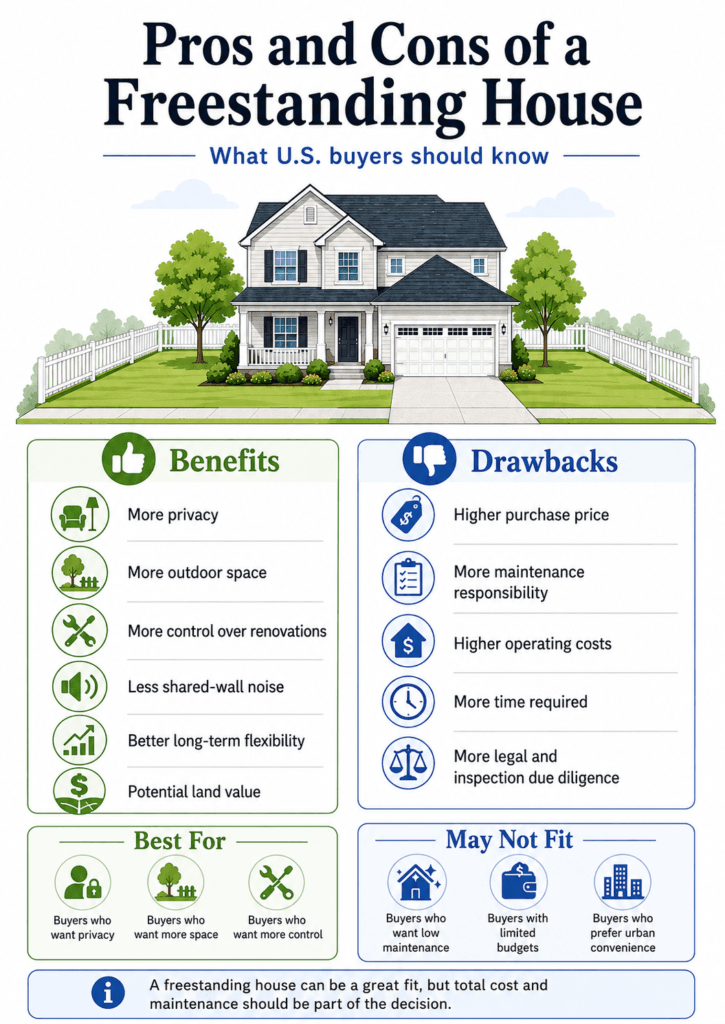
1. More Privacy
A freestanding house usually offers more privacy than attached housing because it does not share walls with neighbors. This can reduce noise transfer and give residents more physical separation.
Privacy still depends on lot size, fence design, window placement, landscaping, and the distance between homes.
2. More Outdoor Space
Many freestanding houses include a front yard, backyard, side yard, driveway, patio, porch, or garden area. This space can support daily living and future improvements.
Possible uses include:
- Gardening
- Outdoor dining
- Play area
- Pet space
- Patio seating
- Storage shed
- Fire pit, if allowed
- Pool, if allowed
- Accessory dwelling unit, if allowed
Local zoning and HOA rules may limit some of these uses.
3. More Control Over Renovations
Detached homes often give owners more control over exterior and interior renovations than condos or apartments. Owners may be able to remodel rooms, expand living areas, add a deck, build a garage, replace siding, or redesign landscaping.
However, this control is not unlimited. Zoning rules, building codes, HOA covenants, easements, setbacks, historic district rules, and permit requirements can restrict changes.
4. Less Shared-Wall Noise
Because a freestanding house does not share walls with another dwelling, it can reduce noise from neighboring units. This can matter for families, remote workers, musicians, pet owners, and buyers who value quiet space.
Noise can still come from roads, nearby houses, yards, HVAC equipment, and neighborhood activity.
5. Better Long-Term Flexibility
A freestanding house may adapt more easily to changing needs. Owners may add a bedroom, build a home office, create outdoor living space, improve accessibility, add storage, or reconfigure the layout.
This flexibility can help families, multigenerational households, and owners who plan to stay for many years.
6. Potential Land Value
In many U.S. markets, land is a major part of detached home value. A freestanding house in a strong location may benefit from limited land supply and strong buyer demand.
However, a detached home is not automatically a good investment. Value depends on location, condition, school district, taxes, local jobs, zoning, neighborhood demand, insurance cost, and broader market conditions.
Drawbacks of a Freestanding House
1. Higher Purchase Price
Freestanding houses often cost more than attached homes in the same area because they usually include more land, more privacy, and more control. The price gap can be large in cities and high-demand suburbs.
2. More Maintenance Responsibility
The owner usually handles the entire property. This includes roof, siding, windows, doors, gutters, landscaping, driveway, fences, HVAC, plumbing, electrical systems, drainage, and pest control.
A condo owner may pay association fees for shared maintenance. A renter may rely on a landlord. A detached homeowner usually has more direct responsibility.
3. Higher Operating Costs
Detached homes can cost more to heat, cool, insure, and maintain. Larger floor areas, exposed exterior walls, older systems, and yard maintenance can increase monthly and annual costs.
4. More Time Required
Owning a freestanding house can take time. Yard work, seasonal maintenance, repairs, contractor scheduling, inspections, and emergency fixes become part of ownership.
This may not suit buyers who travel often, dislike maintenance, or want a low-effort lifestyle.
5. More Due Diligence Before Buying
A detached home can involve more checks than a rental or condo. Buyers should review the title, survey, property boundaries, zoning, easements, setbacks, permits, flood risk, insurance cost, and physical condition.
Skipping these checks can create expensive problems later.
True Cost of Owning a Freestanding House in the U.S.
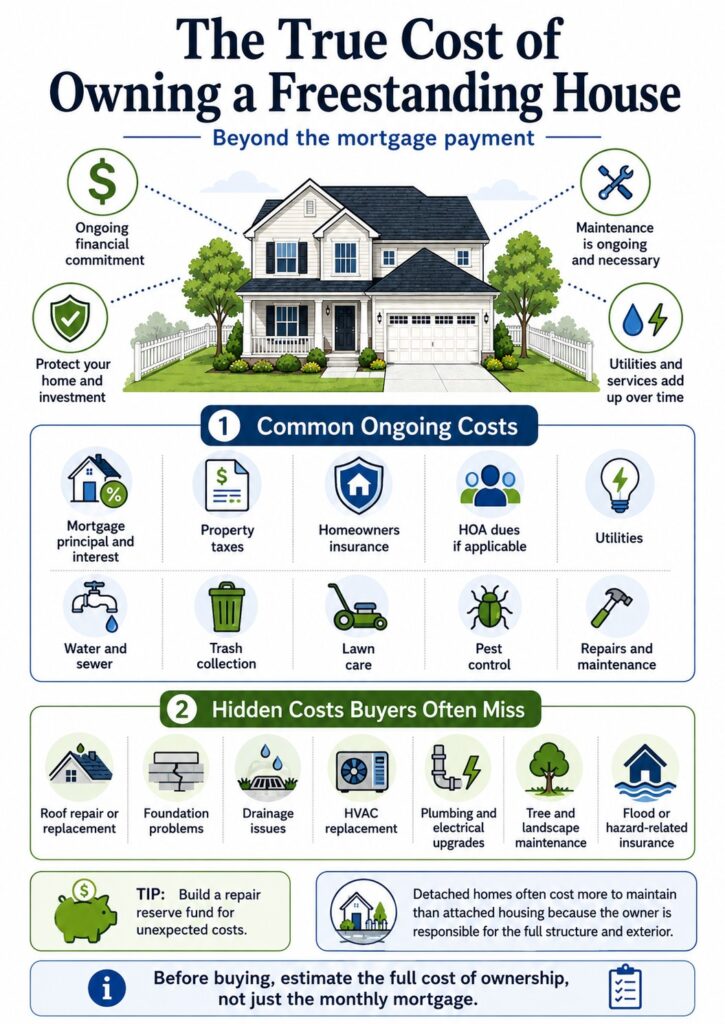
The mortgage payment is only part of the cost. Buyers should calculate the full cost of ownership before making an offer.
Common Costs
A U.S. homeowner may need to budget for:
- Mortgage principal and interest
- Property taxes
- Homeowners insurance
- Mortgage insurance, if required
- HOA dues, if applicable
- Utilities
- Water and sewer
- Trash collection
- Lawn care
- Pest control
- Roof maintenance
- Gutter cleaning
- HVAC service
- Plumbing repairs
- Electrical repairs
- Exterior painting
- Fence repair
- Driveway maintenance
- Tree trimming
- Security systems
- Emergency repairs
Hidden Costs Buyers Often Miss
Roof repair or replacement
A roof can be expensive to replace. Ask about age, material, installation quality, ventilation, leaks, and warranty.
Foundation problems
Foundation repairs can be costly. Watch for cracks, uneven floors, sticking doors, water intrusion, and soil movement.
Drainage problems
Poor drainage can damage foundations, basements, crawl spaces, landscaping, and exterior walls. Check grading, gutters, downspouts, sump pumps, and flood risk.
HVAC replacement
Heating and cooling systems have limited service life. Ask about age, service history, efficiency, and replacement cost.
Plumbing and electrical upgrades
Older homes may need new wiring, panel upgrades, pipe replacement, water heater replacement, or sewer line repair.
Tree and landscape maintenance
Mature trees can increase curb appeal, but they can also create maintenance costs. Roots, branches, leaf buildup, and storm damage can become expensive.
Insurance risk
Homeowners insurance can be higher in areas exposed to hurricanes, wildfires, tornadoes, hail, flooding, earthquakes, or coastal wind. Flood insurance may require a separate policy.
Legal and Regulatory Checks for U.S. Buyers
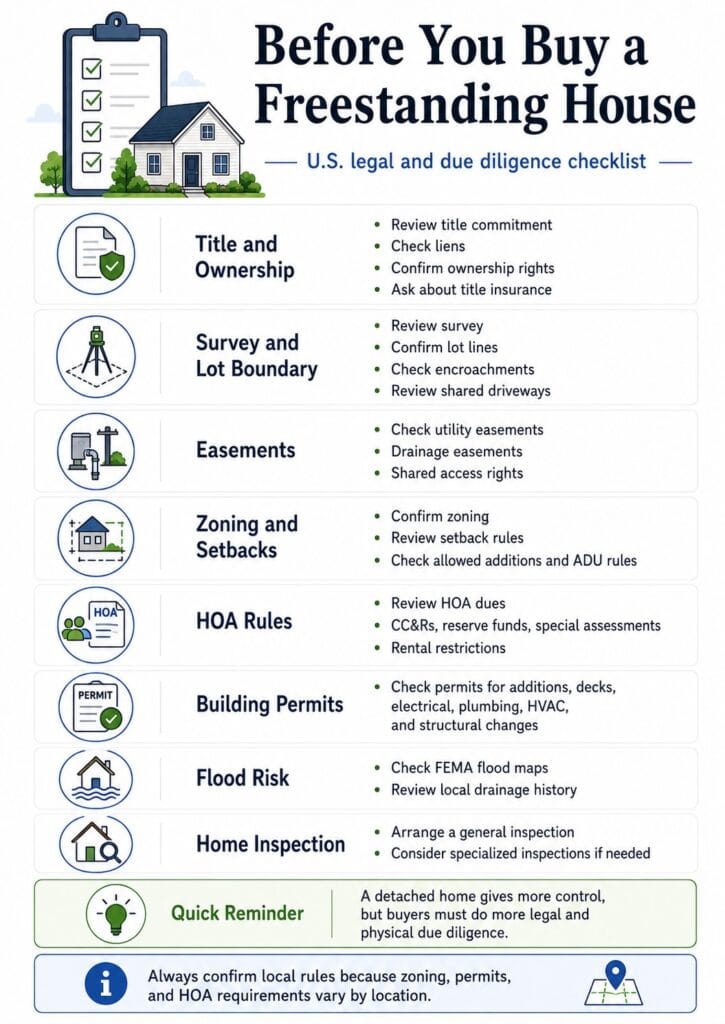
Laws and rules vary by state, county, city, and community. Always confirm local requirements before buying.
1. Title
Title shows legal ownership and can reveal liens, restrictions, easements, claims, or other issues. A title search helps confirm whether the seller can transfer ownership.
Buyers often receive a title commitment before closing. Review it carefully with a real estate attorney, title company, or qualified professional.
2. Title Insurance
Title insurance can protect against certain ownership problems discovered after purchase. A lender may require a lender’s title policy. An owner’s policy may be optional but can protect the buyer’s interest.
Ask what the title policy covers and what it excludes.
3. Survey and Lot Boundary
A survey shows the property boundaries and may reveal encroachments, fences outside the legal line, shared driveways, easements, and setback issues.
Do not assume fences, hedges, or walls match the legal boundary.
4. Easements
An easement gives another person, utility, government entity, or neighbor a legal right to use part of the property for a specific purpose.
Common easements include:
- Utility access
- Sewer lines
- Drainage
- Shared driveway
- Access road
- Maintenance access
An easement can limit where you build, fence, plant, dig, or park.
5. Zoning
Zoning controls how land can be used. It may affect home businesses, rentals, accessory dwelling units, garages, additions, lot splits, and redevelopment.
Check zoning before assuming you can expand, rent, subdivide, or build additional structures.
6. Setbacks
Setbacks are required distances between a structure and property lines, streets, side yards, rear yards, or other buildings.
Setbacks can affect:
- Additions
- Decks
- Pools
- Sheds
- Garages
- Fences
- Accessory dwelling units
- Home expansion
7. HOA Rules
Some detached homes are part of a homeowners association. An HOA may regulate exterior paint, fences, landscaping, parking, rentals, pets, trash bins, noise, additions, and maintenance standards.
Before buying, review:
- HOA dues
- Covenants, conditions, and restrictions
- Bylaws
- Rules and regulations
- Reserve funds
- Special assessments
- Meeting minutes
- Rental restrictions
- Architectural approval process
8. Building Permits
Check whether past renovations were permitted. Unpermitted work can create safety issues, insurance problems, financing delays, appraisal concerns, and resale difficulties.
Ask about permits for:
- Additions
- Decks
- Finished basements
- Garages
- Electrical upgrades
- Plumbing work
- HVAC replacement
- Roof replacement
- Structural changes
9. Flood Risk
Check FEMA flood maps and local flood history. Some lenders require flood insurance if the property is in a high-risk flood zone. Even homes outside mapped high-risk zones can still flood.
Also review drainage, grading, nearby waterways, stormwater systems, and basement or crawl space history.
10. Home Inspection
A home inspection is not automatic. The buyer usually needs to arrange one. A qualified inspector can evaluate the home’s physical condition, major systems, structure, and items that may need repair or replacement.
Inspection should not replace specialized evaluations. You may still need separate inspections for pests, sewer lines, foundation, chimney, roof, mold, radon, septic, well, or environmental hazards.
Buy an Existing Freestanding House or Build One?
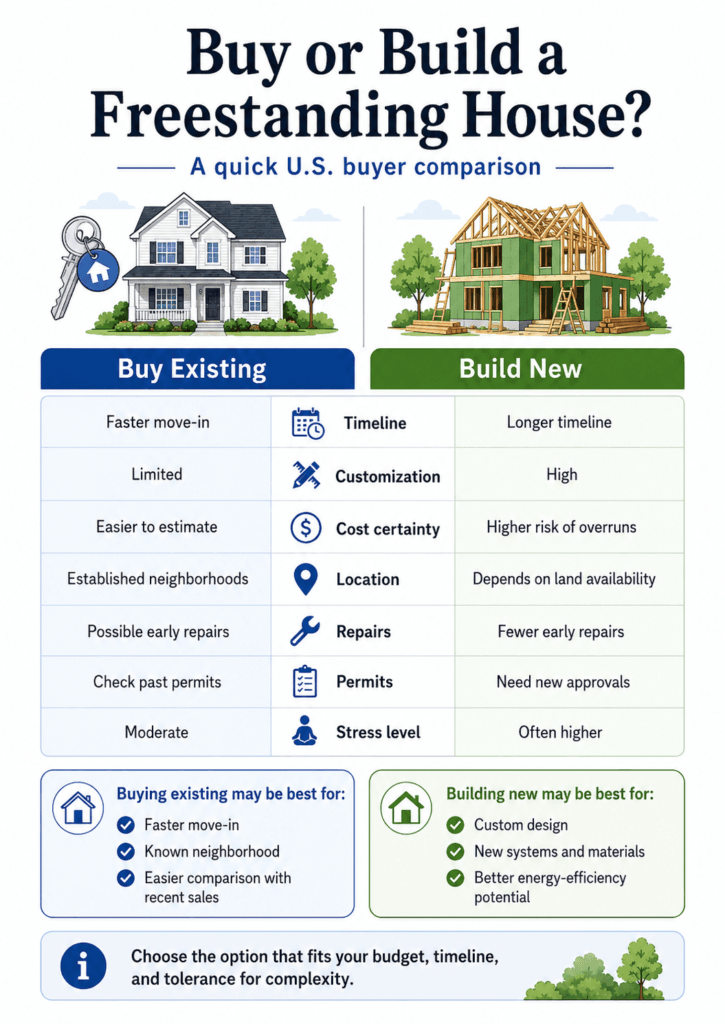
Some buyers choose between buying an existing detached home and building a new one. Both options can work, but they involve different risks.
Buying an Existing Freestanding House
Advantages
- Faster move-in
- Established neighborhood
- Easier to see the actual home
- Existing utilities
- Existing landscaping
- Easier comparison with recent sales
- More predictable location
- Less construction management
Disadvantages
- May need repairs
- Layout may not match your needs
- Older systems may need replacement
- Hidden defects may exist
- Lower energy efficiency
- Less customization
- Past unpermitted work may create risk
Building a New Freestanding House
Advantages
- Custom layout
- Modern systems
- New materials
- Better energy efficiency potential
- More design control
- New construction warranties may apply
- Fewer immediate repair needs
Disadvantages
- Longer timeline
- Land purchase may be difficult
- Permits and approvals can delay the project
- Construction costs can rise
- Contractor quality matters
- Financing can be more complex
- Weather and supply delays can occur
- Final cost can exceed the original estimate
Buy vs. Build Comparison
| Factor | Buy Existing House | Build New House |
| Timeline | Usually faster | Usually slower |
| Customization | Limited | High |
| Cost certainty | Easier to estimate | Higher risk of overruns |
| Location | Established neighborhoods | Depends on land availability |
| Repairs | Possible early repairs | Fewer early repairs |
| Permits | Need to check past permits | Need new approvals |
| Stress level | Moderate | Often higher |
| Best for | Buyers who want faster move-in and known location | Buyers who want control and can manage complexity |
Who Should Consider a Freestanding House?
A freestanding house may fit you if you:
- Want more privacy
- Want a yard
- Need more indoor and outdoor space
- Have children or pets
- Want more design control
- Plan to stay long term
- Can handle maintenance
- Can afford repairs and taxes
- Want fewer shared-wall concerns
- Value land ownership
Who May Prefer Another Housing Type?
A freestanding house may not fit you if you:
- Want low maintenance
- Prefer urban density
- Have a limited budget
- Do not want yard work
- Travel often
- Prefer shared amenities
- Want predictable monthly costs
- Do not want repair responsibility
- Prefer renting flexibility
A townhouse, condo, co-op, or apartment may work better for those needs.
Checklist Before Buying a Freestanding House in the U.S.
Property Type
- Confirm whether the listing is single-family detached.
- Check whether the home shares any wall, roof, garage wall, or structural element.
- Confirm whether it is fee simple, condominium, planned unit development, or HOA-managed.
- Verify whether any accessory dwelling unit exists.
Title and Ownership
- Review the title commitment.
- Check for liens.
- Check for easements.
- Check for covenants.
- Confirm ownership rights.
- Ask about title insurance.
- Consult a real estate attorney if needed.
Survey and Boundary
- Ask whether a recent survey exists.
- Confirm the lot lines.
- Check fence placement.
- Check encroachments.
- Review shared driveways.
- Check access rights.
Zoning and Permits
- Confirm zoning classification.
- Check allowed uses.
- Check setback requirements.
- Check rules for additions, garages, decks, and accessory dwelling units.
- Review past permits.
- Check for unpermitted work.
HOA and Community Rules
- Confirm whether the home is in an HOA.
- Review HOA dues.
- Review CC&Rs.
- Check architectural rules.
- Check rental restrictions.
- Review reserve funds.
- Ask about special assessments.
- Read recent HOA meeting minutes.
Physical Condition
- Hire a home inspector.
- Check roof age.
- Check foundation.
- Check grading and drainage.
- Check HVAC.
- Check plumbing.
- Check electrical panel.
- Check windows and doors.
- Check insulation and ventilation.
- Check pests.
- Check water damage.
- Check sewer or septic system.
- Check well system, if applicable.
Financial Review
- Estimate mortgage payment.
- Estimate property taxes.
- Estimate insurance.
- Estimate utilities.
- Estimate HOA dues.
- Estimate repair costs.
- Build an emergency fund.
- Compare recent sales.
- Review closing costs.
- Check whether flood insurance is required.
- Review long-term affordability.
Location and Resale
- Check school district.
- Check commute.
- Check neighborhood safety.
- Check future development plans.
- Check local taxes.
- Check market demand.
- Check noise sources.
- Check environmental risks.
- Review resale appeal.
Common Mistakes to Avoid
Mistake 1: Assuming “detached” means no rules
A detached home can still be controlled by zoning, setbacks, HOA rules, easements, and building codes.
Mistake 2: Ignoring non-mortgage costs
Property taxes, insurance, utilities, maintenance, and repairs can change affordability.
Mistake 3: Skipping the inspection
A home inspection is not automatic. Arrange one before closing whenever possible.
Mistake 4: Trusting fences as property lines
Fences may not match legal boundaries. Review the survey.
Mistake 5: Not checking flood risk
Flood risk affects insurance, safety, maintenance, and resale. Check FEMA maps and local history.
Mistake 6: Ignoring HOA documents
HOA rules can limit rentals, parking, fences, paint colors, pets, and renovations.
Mistake 7: Assuming all renovations were permitted
Unpermitted work can create safety and resale problems.
Mistake 8: Buying too much house
A larger detached home can bring higher taxes, higher utilities, and more maintenance.
FAQ About Freestanding Houses in the U.S.
What is a freestanding house in the U.S.?
A freestanding house is a home that stands independently and does not share structural walls, a roof, or the main building frame with another dwelling. In U.S. real estate, it is usually called a single-family detached house.
Is a freestanding house the same as a detached house?
Usually yes. “Detached house” is the more common U.S. term. “Freestanding house” describes the same basic idea of a home that physically stands alone.
Is a freestanding house always a single-family home?
Usually, but not always in every legal context. A freestanding house describes the building shape. A single-family home describes use by one household. Some single-family homes, such as townhouses, can be attached.
Does a freestanding house always come with land?
Often, but buyers must check the title. Some detached homes may be part of condominium, HOA, planned unit development, or leasehold arrangements.
Is a townhouse a freestanding house?
No. A townhouse usually shares at least one wall with another home. It may be a single-family home, but it is not freestanding if it is attached.
Is a detached condo possible?
Yes. Some communities have detached homes that are legally condominiums. The home may look freestanding, but ownership and maintenance rules may follow condo documents.
Is a freestanding house more expensive than a townhouse?
Often yes in the same area because it usually includes more land and privacy. The exact price depends on location, condition, size, taxes, HOA, and market demand.
What are the main costs of owning a freestanding house?
Main costs include mortgage payment, property taxes, homeowners insurance, utilities, repairs, maintenance, landscaping, pest control, and HOA dues if applicable.
What should I check before buying a freestanding house?
Check title, survey, lot boundaries, easements, zoning, setbacks, HOA rules, permits, flood risk, inspection results, property taxes, insurance cost, and future resale demand.
Is a home inspection required?
Not always. Buyers usually need to arrange and pay for a home inspection themselves. A lender appraisal is not the same as a full home inspection.
Can a freestanding house be in an HOA?
Yes. Many detached homes in subdivisions and planned communities are part of an HOA.
Can I renovate a freestanding house freely?
Not always. Renovations may require permits and may be limited by zoning, setbacks, HOA rules, easements, historic district rules, and building codes.
Is a freestanding house a good investment?
It can be, especially in strong locations with limited land supply. However, investment performance depends on market conditions, maintenance costs, taxes, insurance, location, and property condition.
Should I buy or build a freestanding house?
Buy if you want faster move-in and an established location. Build if you want customization and can handle land purchase, permits, contractors, delays, and cost risk.
Who should buy a freestanding house?
A freestanding house is best for buyers who want privacy, land, outdoor space, long-term flexibility, and more control over the property.
Who should avoid a freestanding house?
Buyers who want low maintenance, lower responsibility, shared amenities, or urban convenience may prefer a condo, townhouse, co-op, or apartment.
Conclusion
A freestanding house in the U.S. is usually a single-family detached house. It stands on its own and does not share structural walls, a roof, or the main building frame with another dwelling.
This type of home can offer privacy, space, outdoor use, renovation flexibility, and stronger control over the property. It can also require higher purchase costs, higher maintenance, more repairs, more legal checks, and more financial planning.
Before buying, review the title, survey, lot boundaries, easements, zoning, setbacks, HOA rules, permits, inspection results, flood risk, taxes, insurance, and long-term maintenance needs.
A freestanding house can be an excellent choice for buyers who want independence and space. It is not the right choice for everyone. The best decision depends on your budget, lifestyle, location, maintenance tolerance, and long-term plans.
Sources
- U.S. Census Bureau, “Survey of Construction Definitions”
Used for U.S. housing terms such as single-family detached homes, attached homes, townhouses, condominiums, co-ops, HOA, and fee simple ownership.
https://www.census.gov - Consumer Financial Protection Bureau, “Ready to Buy a Home?”
Used for homeownership costs such as repairs, property taxes, homeowners insurance, and HOA dues.
https://www.consumerfinance.gov - U.S. Department of Housing and Urban Development, “For Your Protection: Get a Home Inspection”
Used for the explanation of why buyers should arrange an independent home inspection before purchasing a home.
https://www.hud.gov - Federal Emergency Management Agency, “Flood Maps”
Used for the recommendation to check flood risk before buying a property in the United States.
https://www.fema.gov - Freddie Mac, “Homeownership Costs”
Used for ongoing ownership costs such as private mortgage insurance, taxes, homeowners insurance, and HOA fees.
https://myhome.freddiemac.com

 Shery
Shery